A LOOK INSIDE THE GEMSTONES SUBSECTOR IN RWANDA’S MINING SECTOR
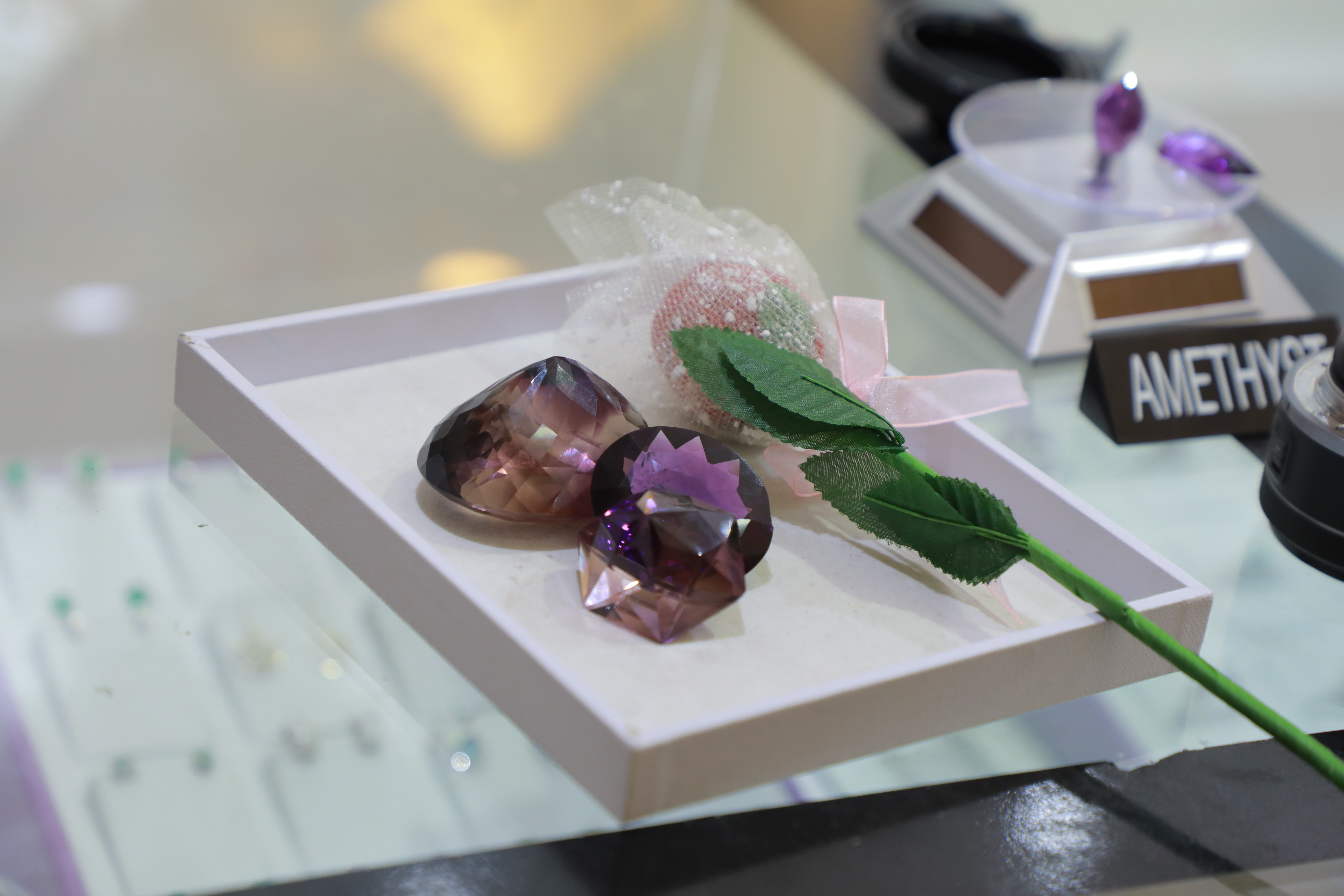
Kigali, March 10 - Gemstones are renowned to many for their exquisite beauty attracting anyone who spots them. Rarely have people entertained the idea that Rwanda does possess precious stones needless to mention other types of minerals.
Depending on their nature and characteristics, which may include color, clarity, transparency, shape, or optical phenomenon, gemstones are faceted, shaped into cabochons, beads, or baroque to be set on jewelry or as decorative objects such as small sculptures.
Data from a gemstone exploration program undertaken since 2018 as part of a capacity building program combined with data from previous explorers and researchers dating back to the colonial era confirm that Rwanda has mineralization potential of gemstones.
The gemstones in Rwanda are diverse and comprise common gemstones such as amethyst, sapphire, beryl, tourmaline, spinel…etc as well as uncommon gemstones such as augelite, purpurite, spurrite, and many more.
Gemstones found in Rwanda
Amethyst
Amethyst is the most known gemstone in Rwanda because a significant deposit was discovered in 2015. Since then, several other deposits have been found and all of them are vein-type. Amethyst has been found in the districts of Ngororero, Muhanga, Ruhango, Rusizi and Nyabihu.
Tourmaline
Tourmaline is found in the pegmatites in Rwanda. Black tourmaline or schorl is the most common and found in many districts, but there are also green, pink and blue or blueish green which occur in the district of Ngororero, Muhanga and Rubavu.
Transparent tourmalines are faceted to be set on high end jewelleries. Low to medium grade translucent tourmalines crystals with needle-like and micro-tube inclusions are cut into cabochon to display cat’s eye optical effect (chatoyancy). Low grade tourmalines with many inclusions are fashioned into beads for affordable jewelleries.
Sapphire
Sapphire occurs in the southwestern part of Rwanda in the districts of Rusizi and Nyamasheke. They occur in alluvial deposits but the source rock is believed to be the rift-related Cenozoic volcanic rocks in the region.
Sapphires are expensive gemstones whose value depends very much on colour, clarity, cut and carat weight
Zircon
Red zircon can be found alongside sapphire in secondary deposits in the district of Rusizi and Nyamasheke and at Muhororo sector of the Ngororero district. The crystals are transparent, tumbled with no crystal shape.
Transparent and eye-clean zircons are commonly faceted to show the high lustre, extreme dispersion and scintillation.Translucent zircons with thin needle-like inclusions are cut into cabochon to display the cat’s eye optical effect (chatoyancy).
Due to its brittleness, zircons set on rings are prone to abrasion, and therefore, they are more suitable for earrings or pendants.
Chrysoberyl
Chrysoberyl was found in secondary gravel deposit at Rambura sector of Nyabihu district.
Common Opal
White and brown common opal, i.e. opal without “play of colours”, are found near the Lake Kivu at Mubuga sector in the district of Karongi.
Polycrystalline Quartz
Polycrystalline quartz, chalcedony (carnelian) and jasper, occur alongside opal in the Karongi district, Mubuga sector.
Chalcedony is faceted only if it is near transparent. Polycrystalline quartz is cut to make cabochons and beads. They are mostly used to make affordable jewelleries. Carved ornamental objects can also be made out of polycrystalline quartz.
Topaz
Topaz has been found in river gravel deposit in the district of Nyabihu (Shyira, Rambura and Rurembo sectors).
Topaz is faceted or fashioned into cabochons and beads depending on its clarity and the presence of optical phenomena such as chatoyancy (cat’s eye effect). The blue topaz from Nyabihu district is of high quality.
Chiastolite
Chiastolite (Figure 45) is an opaque variety of the andalusite mineral (Al2SiO5). Chiastolite is found in the Rutsiro district, Mushubati and Rusebeya sectors
Almandine Garnet
Almandine garnet is found in metasediments or granite in Rwanda. It may occur alongside staurolite in the mica-schists at Rubavu and Rutsiro district, Nyamyumba sector or in granite in Rubavu district, Kanama sector or in chlorite-mica schist in Rutsiro district, Murunda sector where the crystals are large and non-weathered.
The use of almandine garnet is diverse: faceted stones, cabochon and beads. Almandine garnet is used in lieu of expensive red gemstones like ruby. It is used to make both high-end and low-end jewelleries.
Gemstone mining is still at low level. Most mining activities evolve around base metal and other industrial materials. There are plenty of opportunities for gemstone mining and processing in Rwanda.
As aligned with the ongoing mineral value addition strategy, gemstones are now being cut and polished by different private companies that in the end produce high-quality pieces of jewelry and ornaments from locally sourced gemstones. Today, more investment in this subsector is still very much needed to scale up the production of high-end products to be taken to international markets.
